APFC Panels: Power Factor, Savings & Sizing — A Practical Guide

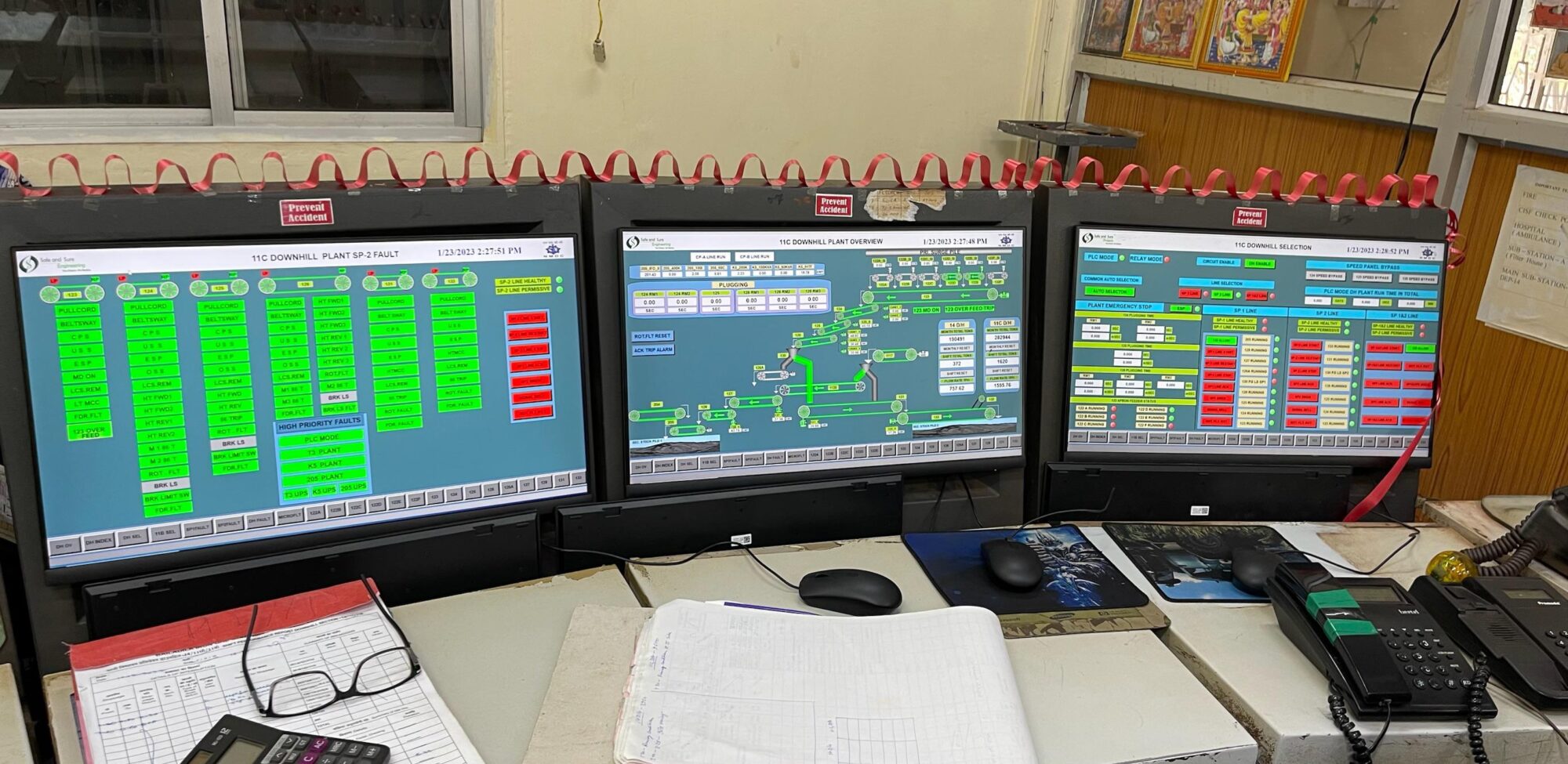
If your plant’s power factor (PF) drops below utility targets (often 0.9–0.95), you pay penalties and waste capacity. APFC (Automatic Power Factor Correction) panels correct PF in real-time using capacitor banks and a controller—often pushing PF to 0.98+, freeing kVA and reducing bills.
What is Power Factor?
Power factor = Real Power (kW) ÷ Apparent Power (kVA).
- Low PF (<0.9) means more current for the same kW → higher losses, voltage drops, and penalties.
- High PF (≥0.98) means efficient use of your electrical network.
Why PF drops: inductive loads (motors, compressors, HVAC, conveyors) draw reactive power (kVAr).
What is an APFC Panel?
An APFC panel switches capacitor banks automatically to offset reactive power. The PF controller measures PF and adds/removes kVAr steps to keep PF near your setpoint.
Core components
- Capacitor banks (stepped: e.g., 25/25/50/50/100 kVAr…)
- Switching: contactors (standard) or thyristor (TSC) for fast, transient-free switching (good for rapidly varying loads)
- Detuned reactors (5.67%/7%/14%) to avoid resonance with harmonics
- Protection and metering: MFM meters, fuses/MCCBs, contactor duty, discharge resistors, ventilation
When Do You Need Detuned Reactors?
Use detuned (reactor-series) banks when you have VFDs, soft starters, UPS, welders, or non-linear loads. Detuning shifts resonance below the 5th harmonic and protects capacitors from overheating/failure.
- Plain capacitor banks: suitable only for clean systems (low THD)
- Detuned banks: recommended for modern plants with drives/electronics
Target Power Factor
Most utilities incentivize ≥0.95; best practice for plants is 0.98–0.99 lag (avoid leading PF).
Simple APFC Sizing (4 Steps)
- Get your data: kW (or kVA & PF), current PF, and target PF (e.g., 0.98).
- Compute required kVAr: kVAr=kW (tanϕ1−tanϕ2)\text{kVAr} = \text{kW}\ (\tan\phi_1 – \tan\phi_2)kVAr=kW (tanϕ1−tanϕ2) where ϕ1=cos−1(PFcurrent)\phi_1 = \cos^{-1}(\text{PF}_\text{current})ϕ1=cos−1(PFcurrent) and ϕ2=cos−1(PFtarget)\phi_2 = \cos^{-1}(\text{PF}_\text{target})ϕ2=cos−1(PFtarget).
- Choose step sizes: multiple small steps (e.g., 12.5, 25, 50 kVAr) for fine control.
- Decide detuning: if THD-V > 3% or many VFDs → use detuned reactors.
Quick Example
- Average load = 500 kW, current PF = 0.82, target PF = 0.98
- ϕ1=cos−1(0.82)=34.7∘\phi_1 = \cos^{-1}(0.82)=34.7^\circϕ1=cos−1(0.82)=34.7∘, tanϕ1=0.69\tan\phi_1=0.69tanϕ1=0.69
- ϕ2=cos−1(0.98)=11.5∘\phi_2 = \cos^{-1}(0.98)=11.5^\circϕ2=cos−1(0.98)=11.5∘, tanϕ2=0.20\tan\phi_2=0.20tanϕ2=0.20
- kVAr ≈ 500 × (0.69 − 0.20) = 245 kVAr
- Choose ~250 kVAr detuned bank with steps like 25+25+50+50+100
Contactors vs Thyristor Switching
- Contactor: economical, fine for relatively steady loads; 40–60 sec rest per step recommended.
- Thyristor (TSC): instantaneous, transient-free—best for fast-varying loads (welders, presses, elevators, test benches).
Where to Install the APFC?
- At PCC (main incomer) for plant-wide PF compliance
- At major MCCs or load groups when large localized swings occur
- Many sites use a hybrid: main APFC + smaller local banks near heavy, variable loads.
Safety, Compliance & Good Engineering
- Follow applicable IEC/IS standards and check fault level, IP rating, temperature rise.
- Provide adequate ventilation; capacitors dislike heat.
- Include detuned reactors for non-linear loads and harmonic-rated capacitors.
- Add door interlocks, discharge resistors, and clear labelling/documentation.
- Ensure FAT/SAT with PF setpoint tuning and alarm checks.
What Savings Can You Expect?
- Penalty reduction: utilities often penalize PF < 0.9–0.95.
- Capacity release: higher PF frees kVA → more load on the same transformer.
- Lower losses: reduced current = lower I²R losses, cooler cables/gear.
Back-of-the-envelope ROI
If penalties and losses together cost ₹40,000/month and APFC CAPEX is ₹4.5–6.5 lakh (detuned, 250–300 kVAr typical), payback can be 12–18 months. Your actual ROI depends on tariff, duty cycle, and harmonics.
Spec Checklist (copy for your RFQ)
- Required kVAr and target PF
- THD levels / presence of VFDs → detuning %
- Step sizes & number of steps (future growth?)
- Switching type (contactor vs thyristor)
- Metering & comms (MFM, Modbus)
- Enclosure rating (IP, Form), cooling
- Protections, interlocks, discharge resistors
- FAT/SAT, test reports, drawings, manuals
- AMC & spares support
FAQs
1) Will APFC fix harmonics?
No. APFC corrects PF. Detuned reactors protect capacitors from harmonics but don’t remove harmonics like active filters do.
2) Can PF become leading?
Yes, if oversized or at low load. Use more steps and proper controller settings to avoid leading PF.
3) Do I need APFC if I already have VFDs?
Usually yes. VFDs improve motor efficiency but don’t guarantee target PF at the PCC. Many plants use both VFDs and APFC.
4) What PF should I set?
Start with 0.98 lag. Tune during commissioning to meet utility rules without going leading.
5) Contactor or thyristor?
For stable loads, contactor is cost-effective. For fast, frequent steps, thyristor switching avoids transients.