VFD Panels: Real-World Energy Savings, Sizing & ROI

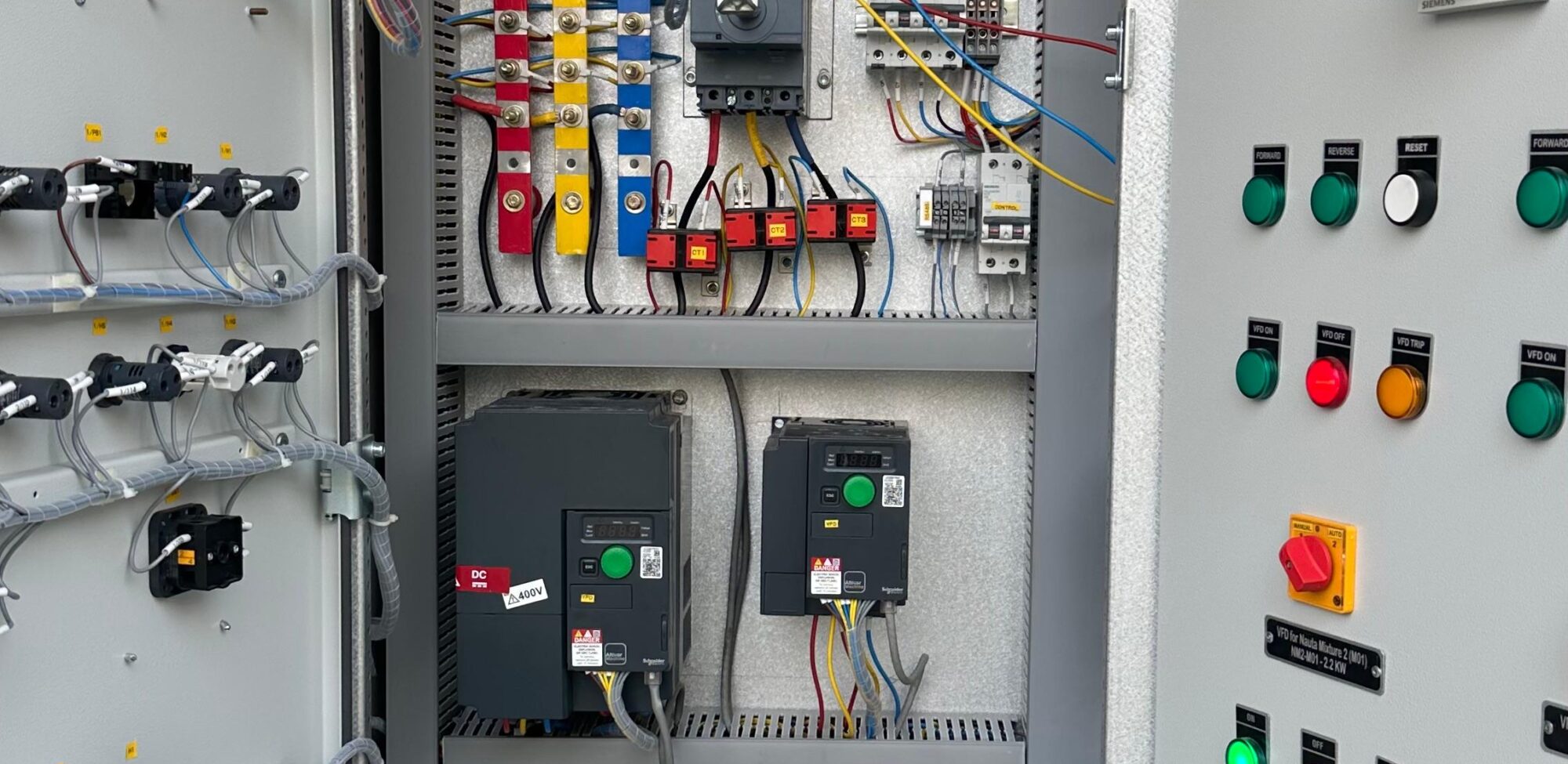
Variable Frequency Drive (VFD) panels control motor speed and torque. On variable-torque loads (pumps/fans), power roughly follows the cube of speed—so even small speed reductions deliver big kWh savings. Expect smoother starts, fewer trips, and quieter operation.
Why VFDs Save Energy (the “cube law”)
For centrifugal pumps/fans: Flow∝Speed,Head∝Speed2,Power∝Speed3\text{Flow} \propto \text{Speed},\quad \text{Head} \propto \text{Speed}^2,\quad \text{Power} \propto \text{Speed}^3Flow∝Speed,Head∝Speed2,Power∝Speed3
If you run at 80% speed, the motor power is about 0.83=0.5120.8^3 = 0.5120.83=0.512 (≈ 49% less than full speed). That’s why replacing throttling/dampers with VFD control cuts bills dramatically.
Example Paybacks (conservative assumptions)
Scenario A — Process Pump (big win)
- Motor: 75 kW; duty: 20 h/day, 300 days/year (6,000 h)
- Before: Valve throttling ≈ 90% of rated power → 67.5 kW
- After VFD: Average speed ≈ 80% → 75×0.83=38.475 \times 0.8^3 = 38.475×0.83=38.4 kW
- Savings: 67.5−38.4=29.167.5 – 38.4 = 29.167.5−38.4=29.1 kW
- Annual kWh saved: 29.1×6,000=174,60029.1 \times 6{,}000 = 174{,}60029.1×6,000=174,600 kWh
- At ₹9/kWh → ₹15.71 lakh/year saved
- Typical 90 kW VFD panel CAPEX: ₹6–9 lakh → Payback < 1 year (conditions vary).
Scenario B — Supply Fan (steady but smaller)
- Motor: 30 kW; duty: 12 h/day, 365 days (4,380 h)
- Speed reduction: 90% → power =0.93=0.729= 0.9^3 = 0.729=0.93=0.729
- Savings fraction: 1−0.729=0.2711 – 0.729 = 0.2711−0.729=0.271
- kW saved: 30×0.271=8.1330 \times 0.271 = 8.1330×0.271=8.13 kW
- Annual kWh saved: 8.13×4,380≈35,6098.13 \times 4{,}380 \approx 35{,}6098.13×4,380≈35,609 kWh
- At ₹9/kWh → ₹3.20 lakh/year saved
Actual results depend on duty cycle, system curves, and utility tariffs. Use your logged load data for precise estimates.
Where VFDs Shine vs Where They Don’t
Best suited for:
- Centrifugal pumps/fans, blowers, cooling towers, AHUs, chilled water loops, conveyors with variable throughput.
Limited benefit on:
- Constant-torque loads at fixed speed (elevators, positive displacement pumps) unless process requires speed control or soft start.
- Very short duty cycles where energy savings don’t offset CAPEX.
Sizing & Spec (copy this for your RFQ)
1) Motor & duty
- Rated kW/HP, voltage, FLA, service factor, ambient, enclosure (IP).
- Duty profile (hours/day, speed range, starts/hour), process setpoint logic.
2) Drive selection
- VFD rating ≥ motor kW with margin; heavy-duty rating if frequent overloads.
- Input: 3-phase (line reactor if THD/weak grid). Output: dv/dt or sine filter if motor cable > 50–100 m or old insulation.
- Braking (DB/regen) if rapid decel needed.
- Harmonics: 3%/5% line reactors or 12-pulse/active front end for strict limits.
3) Panel build
- Proper ventilation (derating for temp), segregated power/control wiring, EMC practices.
- Bypass (manual/auto) for critical services.
- Meters (kW, kWh, PF), communications (Modbus/Profibus/Profinet/EtherNet/IP).
- Interlocks (low flow/pressure, damper status, pump permissives).
4) Controls & protection
- PID control, min/max speed limits, ramp profiles, sleep/wake logic.
- Overload, short-circuit, earth fault protection coordination with upstream breakers.
- Alarms/events logging; trend data to SCADA/BMS.
5) Testing & docs
- FAT with I/O simulation, harmonic snapshot, parameter backup.
- SAT, as-built drawings, O&M manuals, spare parts list, training.
Harmonics & Power Quality in Plain English
VFDs inject harmonics. Keep the grid happy with:
- Line reactors (simple, cost-effective)
- DC chokes (built-in on many drives)
- Detuned APFC at PCC (avoid resonance; VFDs ≠ PF correction at PCC)
- Active filters/AFE when compliance is tight or many large drives run together
Reliability & Maintenance
- Soft starts reduce mechanical stress on shafts, couplings, belts.
- Motor life: lower thermal shock; check bearing currents on large motors (insulated bearings/shaft grounding if needed).
- Keep panels dust-free; ensure fans/filters are serviced; back up parameters.
Mini Calculator (paste into your sheet)
- Average speed fraction SSS (e.g., 0.8 for 80%)
- Rated power PrP_rPr (kW)
- Baseline power fraction BBB (1.0 if damper/valve fully open; 0.9 if throttled)
- kW saved =Pr×(B−S3)= P_r \times (B – S^3)=Pr×(B−S3)
- Annual kWh saved =kW saved×hours/year= \text{kW saved} \times \text{hours/year}=kW saved×hours/year
- Annual ₹ saved =kWh saved×tariff= \text{kWh saved} \times \text{tariff}=kWh saved×tariff
FAQs
Q1: Do I still need APFC after installing VFDs?
Usually yes. VFDs don’t guarantee target PF at the PCC. Use detuned APFC to hit 0.98+ plant-wide.
Q2: Will a VFD hurt my motor?
Not when engineered right. Use dv/dt or sine filters for long cables/older motors and follow OEM derating for ambient and altitude.
Q3: Do I need a bypass?
For critical services (e.g., fire pumps—subject to code), a bypass or alternate supply is recommended.
Q4: What about harmonics compliance?
Most plants meet limits with line reactors; for strict THDi/THDv, consider active filters or AFE.
Q5: Can I network VFDs to SCADA/BMS?
Yes—common protocols include Modbus, Profibus, Profinet, EtherNet/IP, BACnet.