PCC Panels: Ratings, ACB Selection & Design Checklist (IEC 61439)

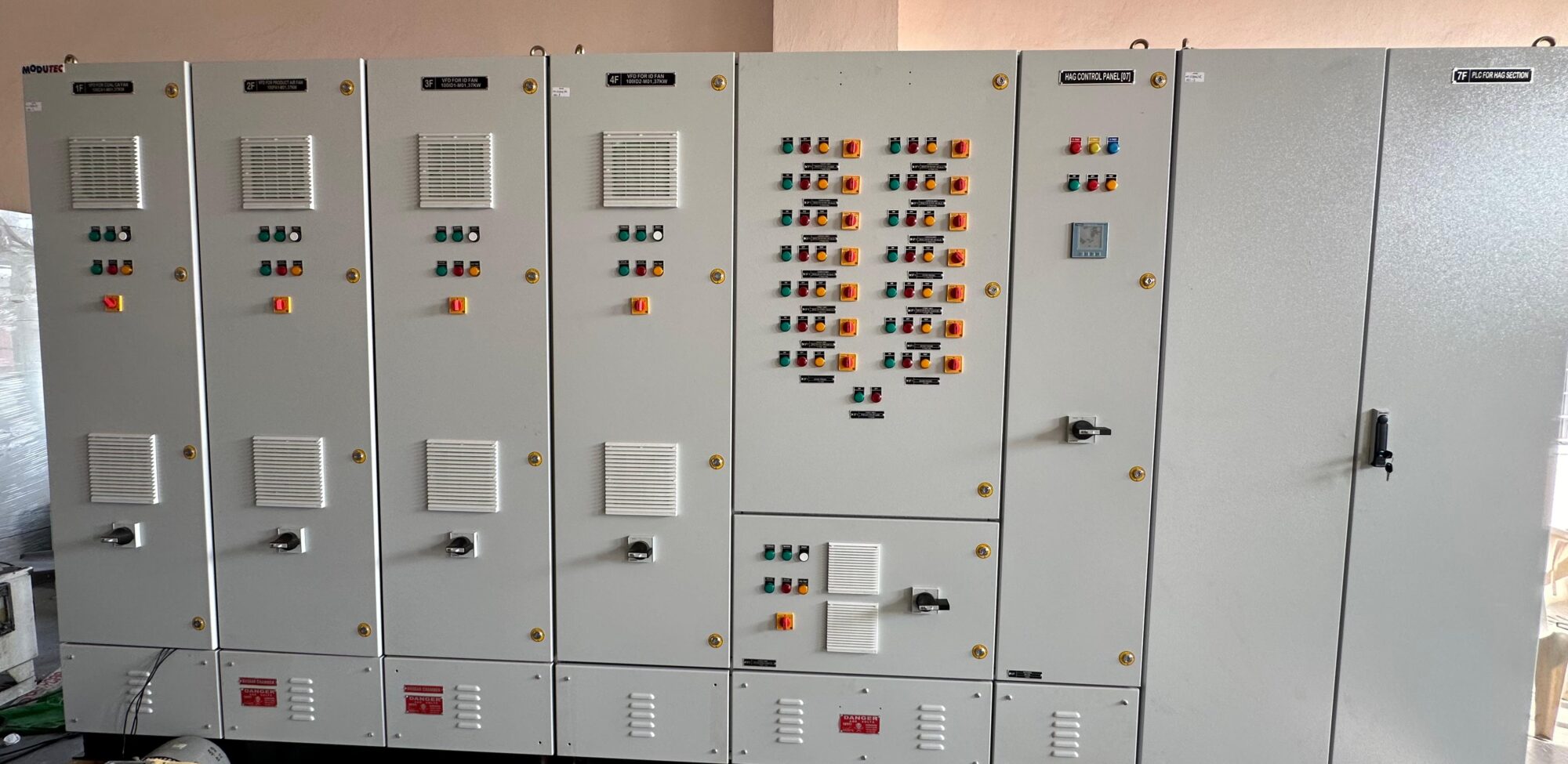
A PCC (Power Control Center) panel is your main LV distribution board. Get four things right—fault level, ACB selection, busbar design, and separation form—and you’ll improve safety, uptime, and expansion headroom.
What a PCC Panel Does (in plain English)
- Receives power at LV from transformer/UPS/genset
- Protects through ACB/MCCB with coordinated trips
- Distributes to MCCs, sub-panels, UPS, and process loads
- Measures energy and power quality for decisions
Quick contrast: PCC = main power distribution, MCC/iMCC = motor feeders.
Typical PCC Architecture
- Incomer(s): ACB with LSIG (Long, Short, Instantaneous, Ground) protection
- Bus Coupler: ACB/MCCB (tie) for source redundancy or sectionalizing
- Outgoing Feeders: ACB/MCCB to MCCs/sub-DBs/APFC
- Metering: Multifunction meter (kW, kWh, PF, THD), PQ analyzer if needed
- Comms: Modbus/Profinet/EtherNet/IP for SCADA/energy dashboards
Ratings That Matter (choose these first)
- System voltage & earthing (e.g., 415 V, 3-phase, 50 Hz, TN-S)
- Incomer current (transformer kVA ÷ (√3×V) × diversity)
- Short-circuit rating (SCCR): e.g., 50 kA/1s or 65 kA/1s (match fault study)
- Service conditions: ambient, altitude, dust/heat → affects derating & IP
ACB quick picks: 1600A / 2000A / 2500A / 3200A / 4000A / 6300A frames with LSIG; define Icw (kA/1s) and Ics/Icu per study.
Busbar & Temperature Rise (the sanity checks)
- Size busbars for continuous current + derating (ambient, enclosure, skin effect)
- Verify temperature rise meets limits (IEC 61439 routine/type tests)
- Busbar supports, clearances, and joints must match fault forces
- Use proper earthing bars with dedicated terminations (no sharing)
(Avoid “rule-of-thumb” sizing—use verified calcs/type-test data.)
Form of Separation (safety & maintainability)
- Form 2b: basic segregation of busbars and functional units
- Form 3b: adds separation between functional units
- Form 4b: highest maintainability—individually separated functional units and terminals
Choose based on uptime, service access, and risk.
Protection & Coordination
- ACB LSIG on incomers/tie; MCCB on feeders with discrimination/backup
- Earth-fault, UV/OV releases, shunt trips, mechanical/electrical interlocks
- Labelled E-Stops, mimic diagrams, and clear door interlocks
Power Quality: APFC & Harmonics
- Plant-wide PF target ≥0.98 using APFC (detuned if VFDs present)
- If THD is high, consider active filters/AFE at source groups
- Keep APFC in a separate section or dedicated panel for thermal/harmonics
Room & Installation Considerations
- Clearances & front access for maintenance (and racking if drawout ACBs)
- Cable entry (top/bottom), bending radius, gland plates, space for future feeders
- Ventilation / panel cooling; dust control; IP rating for environment
- Proper earthing grid and verified torque schedule
FAT, SAT & Documentation (no surprises)
- FAT: visual checks, wiring verification, functional tests, comms, protection settings, insulation resistance
- SAT: on-site interlocks, direction checks, load trials, alarms, final as-builts
- Deliver: SLD, GA, wiring drawings, BoM, test reports, torque chart, O&M manual
RFQ Checklist (paste into your tender)
- System: voltage, earthing, transformer/genset details, fault level study
- Ratings: incomer current, SCCR (kA/1s), ACB frame/poles, feeders list & ratings
- Protection: ACB trip (LSIG) curves, discrimination with downstream MCCs
- Busbars: rating, material, temp-rise compliance, earthing bar
- Form/IP: separation (2b/3b/4b), IP rating, ambient/altitude
- Metering/Comms: MFM/PQ analyzer, protocol (Modbus/Profinet/EtherNet/IP)
- APFC/Harmonics: detuned banks? active filter? placement
- Build details: cable entry, space for future, labels, mimic, interlocks
- Tests/Docs: FAT/SAT scope, reports, as-builts, O&M, training
- Support: warranty, AMC/SLA, spares list
FAQs
1) ACB or MCCB at incomer?
For main PCC incomers, ACB with LSIG is standard—higher breaking capacity, adjustable protection, and serviceability.
2) Is Form 4b overkill?
Not if uptime matters. Form 4b simplifies safe maintenance and isolation. For budget-driven projects, Form 3b can work.
3) Do I always need a bus coupler?
If you have dual sources or want sectionalizing redundancy, yes. It improves continuity and maintenance flexibility.
4) Can APFC sit inside the PCC?
Prefer separate APFC or isolated section with dedicated cooling—capacitors dislike heat and harmonics.
5) What short-circuit rating should I pick?
Base it on a fault level study (transformer kVA, impedance, cable lengths). Common specs: 50/65 kA for 1 s at LV.